Books

Policy briefs

RS4DM: Making farmer clusters work: Key policy strategies for agroenterprise development

More than two million Filipino farmers cultivate farms averaging just over one hectare (Ricelytics, 2022). Small farm size, limited assets, and weak bargaining power restrict their ability to benefit from modern value chains. To address these constraints, the DA has promoted farmer clustering—organizing farmerproducers into cooperatives or functional groups— as a central strategy under the MASAGANA Rice Industry Development Program (MRIDP) and related initiatives.

RS4DM: Ratooning increases rice production (2025)

The local terms for rice ratooning are sagibo in Guimba and sangang-buko in Aliaga, Nueva Ecija. Sangang-buko literally translates as “that which branched out (sanga) from the joint (buko),” providing an accurate depiction of the rice ratooning process. Despite its cultural significance, academic literature focusing on the practices contextualized in these two towns is scarce. Some studies, such as the research by Gajete et al. (2018), explore the potentials of improved rice ratooning technology in rainfed rice production areas to achieve higher yields within shorter periods through prescribed nutrient application. However, fieldwork suggests that rainfed ratooning is generally unpopular among local farmers. Nevertheless, farmers “claim” that ratoon rice has better eating quality than that of the main crop because it is chemical-free…

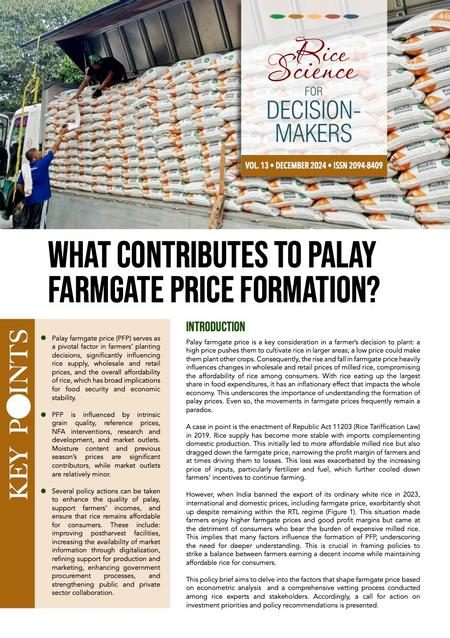
RS4DM: What contributes to palay farmgate price formation? (2024)

Palay farmgate price is a key consideration in a farmer’s decision to plant: a high price pushes them to cultivate rice in larger areas; a low price could make them plant other crops. Consequently, the rise and fall in farmgate price heavily influences changes in wholesale and retail prices of milled rice, compromising the affordability of rice among consumers. With rice eating up the largest share in food expenditures, it has an inflationary effect that impacts the whole economy. This underscores the importance of understanding the formation of palay prices. Even so, the movements in farmgate prices frequently remain a paradox…

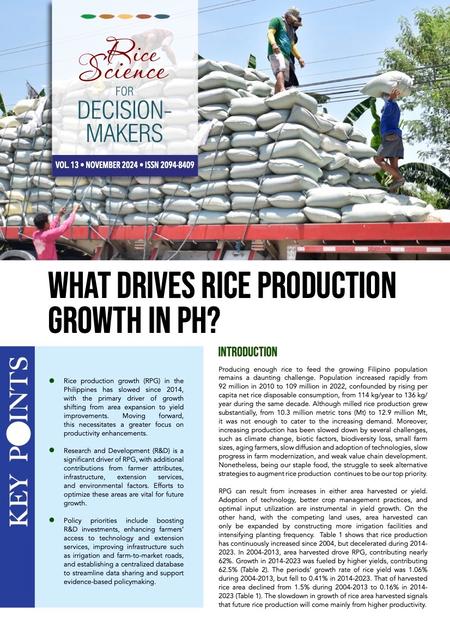
RS4DM: What drives rice production growth in PH? (2024)

Producing enough rice to feed the growing Filipino population remains a daunting challenge. Population increased rapidly from 92 million in 2010 to 109 million in 2022, confounded by rising per capita net rice disposable consumption, from 114 kg/year to 136 kg/year during the same decade. Although milled rice production grew substantially, from 10.3 million metric tons (Mt) to 12.9 million Mt, it was not enough to cater to the increasing demand. Moreover, increasing production has been slowed down by several challenges, such as climate change, biotic factors, biodiversity loss, small farm sizes, aging farmers, slow diffusion and adoption of technologies, slow progress in farm modernization, and weak value chain development. Nonetheless, being our staple food, the struggle to seek alternative strategies to augment rice production continues to be our top priority…

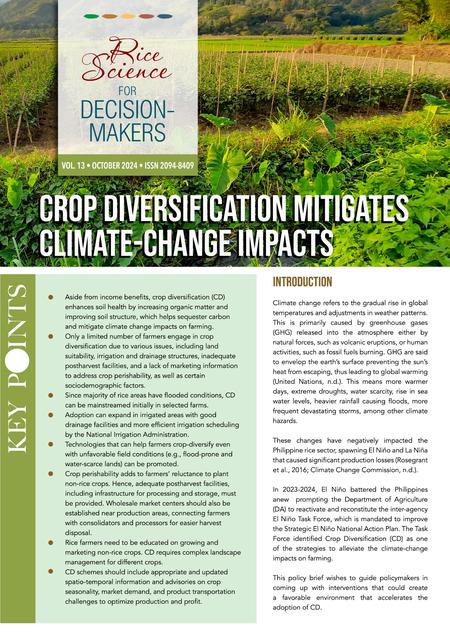
RS4DM: Crop diversification mitigates climate change impacts (2024)

Climate change refers to the gradual rise in global temperatures and adjustments in weather patterns. This is primarily caused by greenhouse gases (GHG) released into the atmosphere either by natural forces, such as volcanic eruptions, or human activities, such as fossil fuels burning. GHG are said to envelop the earth’s surface preventing the sun’s heat from escaping, thus leading to global warming (United Nations, n.d.). This means more warmer days, extreme droughts, water scarcity, rise in sea water levels, heavier rainfall causing floods, more frequent devastating storms, among other climate hazards.

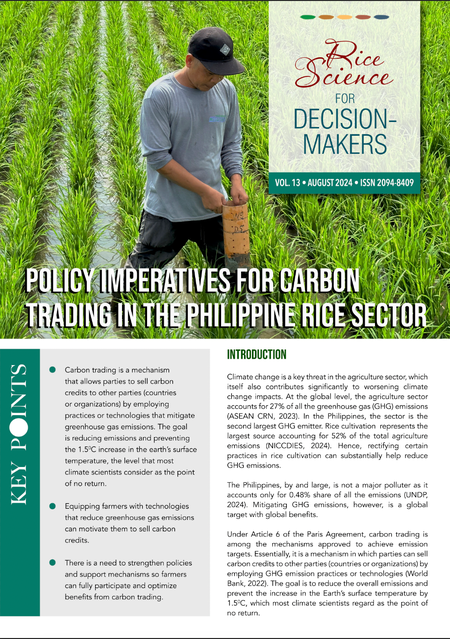
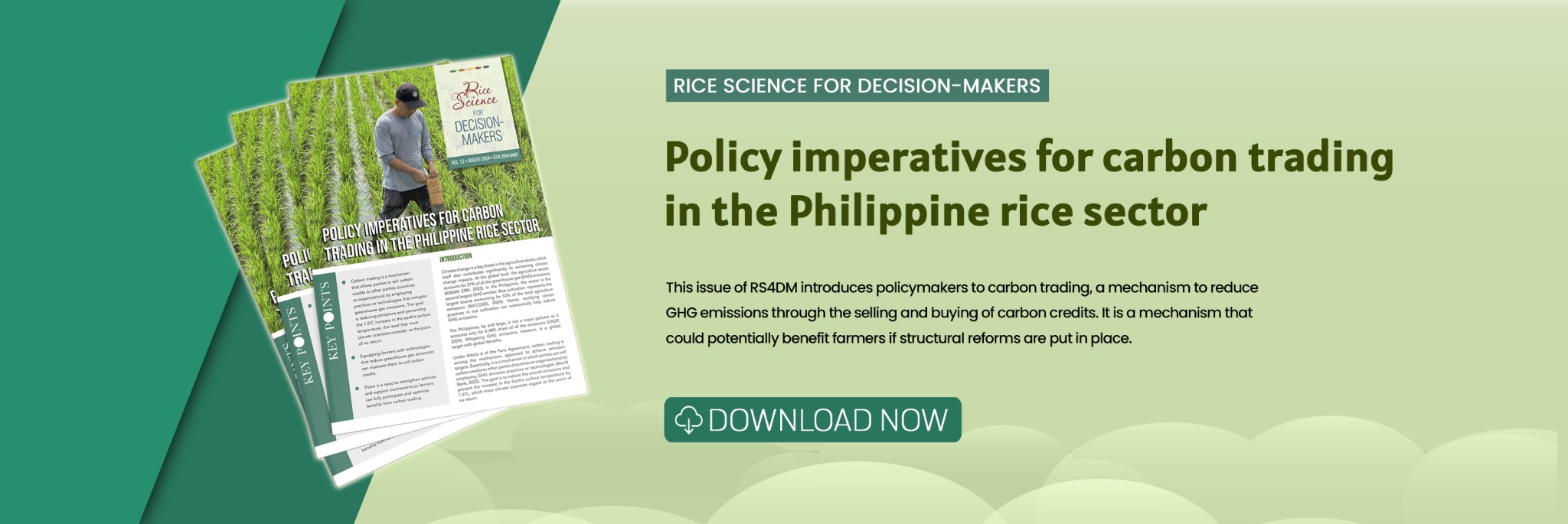
RS4DM: Policy imperatives for carbon trading in the Philippine rice sector (2024)

Climate change is a key threat in the agriculture sector, which itself also contributes significantly to worsening climate change impacts. At the global level, the agriculture sector accounts for 27% of all the greenhouse gas (GHG) emissions (ASEAN CRN, 2023). In the Philippines, the sector is the second largest GHG emitter. Rice cultivation represents the largest source accounting for 52% of the total agriculture emissions (NICCDIES, 2024). Hence, rectifying certain practices in rice cultivation can substantially help reduce GHG emissions.

RS4DM: What does our balanced fertilization study say? (2023)

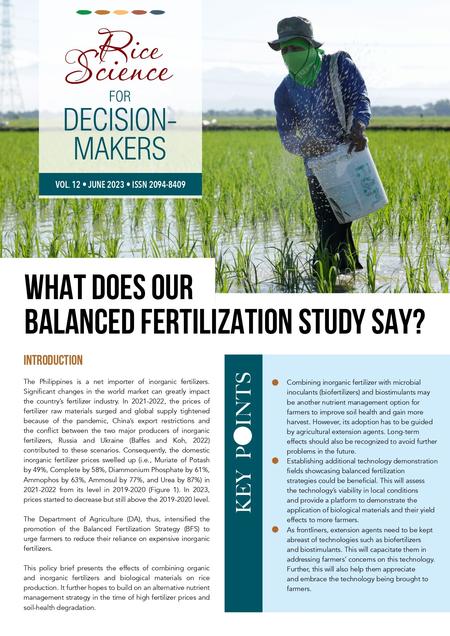
The Philippines is a net importer of inorganic fertilizers.
Significant changes in the world market can greatly impact the country’s fertilizer industry. In 2021-2022, the prices of fertilizer raw materials surged and global supply tightened because of the pandemic, China’s export restrictions and the conflict between the two major producers of inorganic fertilizers, Russia and Ukraine (Baffes and Koh, 2022) contributed to these scenarios. Consequently, the domestic inorganic fertilizer prices swelled up (i.e., Muriate of Potash by 49%, Complete by 58%, Diammonium Phosphate by 61%, Ammophos by 63%, Ammosul by 77%, and Urea by 87%) in 2021-2022 from its level in 2019-2020 (Figure 1). In 2023, prices started to decrease but still above the 2019-2020 level.

RS4DM: Enabling the shift from transplanted to direct-seeded rice systems in the Philippines (2023)

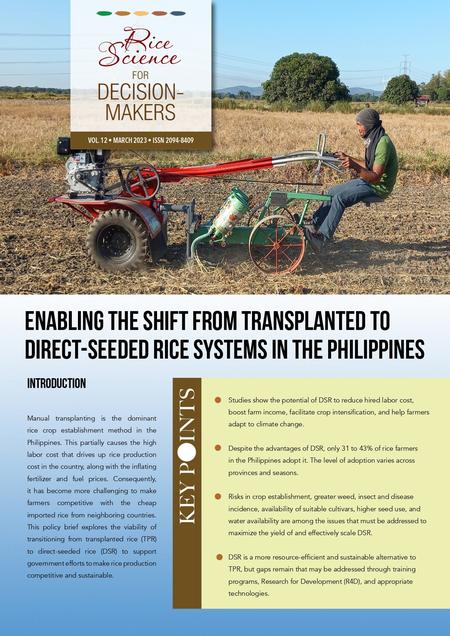
Manual transplanting is the dominant rice crop establishment method in th Philippines. This partially causes the high labor cost that drives up rice production cost in the country, along with the inflating fertilizer and fuel prices. Consequently, it has become more challenging to make farmers competitive with the cheap imported rice from neighboring countries. This policy brief explores the viability of transitioning from transplanted rice (TPR) to direct-seeded rice (DSR) to support government efforts to make rice production competitive and sustainable.

RS4DM: Reinforcing right E-A-T for improved fertilizer application (2022)

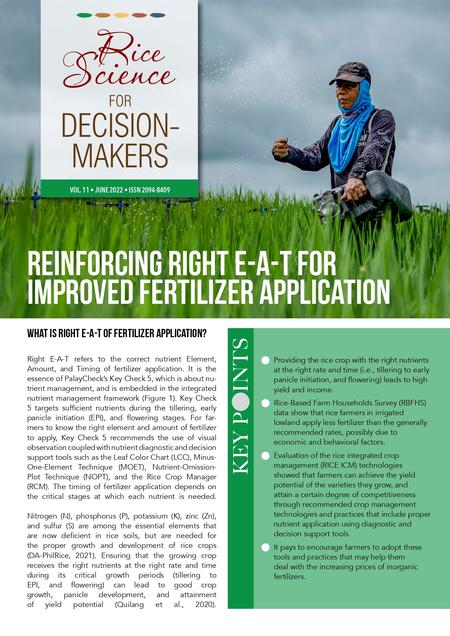
Right E-A-T refers to the correct nutrient Element, Amount, and Timing of fertilizer application. It is the essence of PalayCheck’s Key Check 5, which is about nutrient management, and is embedded in the integrated nutrient management framework (Figure 1). Key Check 5 targets sufficient nutrients during the tillering, early panicle initiation (EPI), and flowering stages. For farmers to know the right element and amount of fertilizer to apply, Key Check 5 recommends the use of visual observation coupled with nutrient diagnostic and decision support tools such as the Leaf Color Chart (LCC), MinusOne-Element Technique (MOET), Nutrient OmissionPlot Technique (NOPT), and the Rice Crop Manager (RCM). The timing of fertilizer application depends on the critical stages at which each nutrient is needed.

Data visualizations in published research papers

Posters

Leaflets

Presentations